


After 91 years on Planet Ocean, Sylvia Earle a/k/a “Her Deepness” still has a lot to say about how to save the ocean. “There is no sustainable extraction of krill in Antarctica possible, period,” Earle said at the latest annual summit of the Commission for the Conservation of Antarctic Marine Living Resources (CCAMLR). CCAMLR manages the Antarctic krill fishery, which closed in August this year after reaching its quota of 620,000 metric tons. The fishery also closed in August last year due to industrial fishing by two countries: Norway and China. The leading krill fishing company, Aker BioMarine, was recently privatized by American Industrial Partners, a New York private equity firm. Aker BioMarine was founded by Norwegian billionaire Kjell Inge Rokke who created the market for krill to be used as red omega-3 supplements and industrial fish farm feed. But, as Earle further remarked, krill are not the only available source of omega-3. “It’s all for choices,” not necessity. In Earle’s opinion, there is no sustainable level of harvest when it comes to krill.
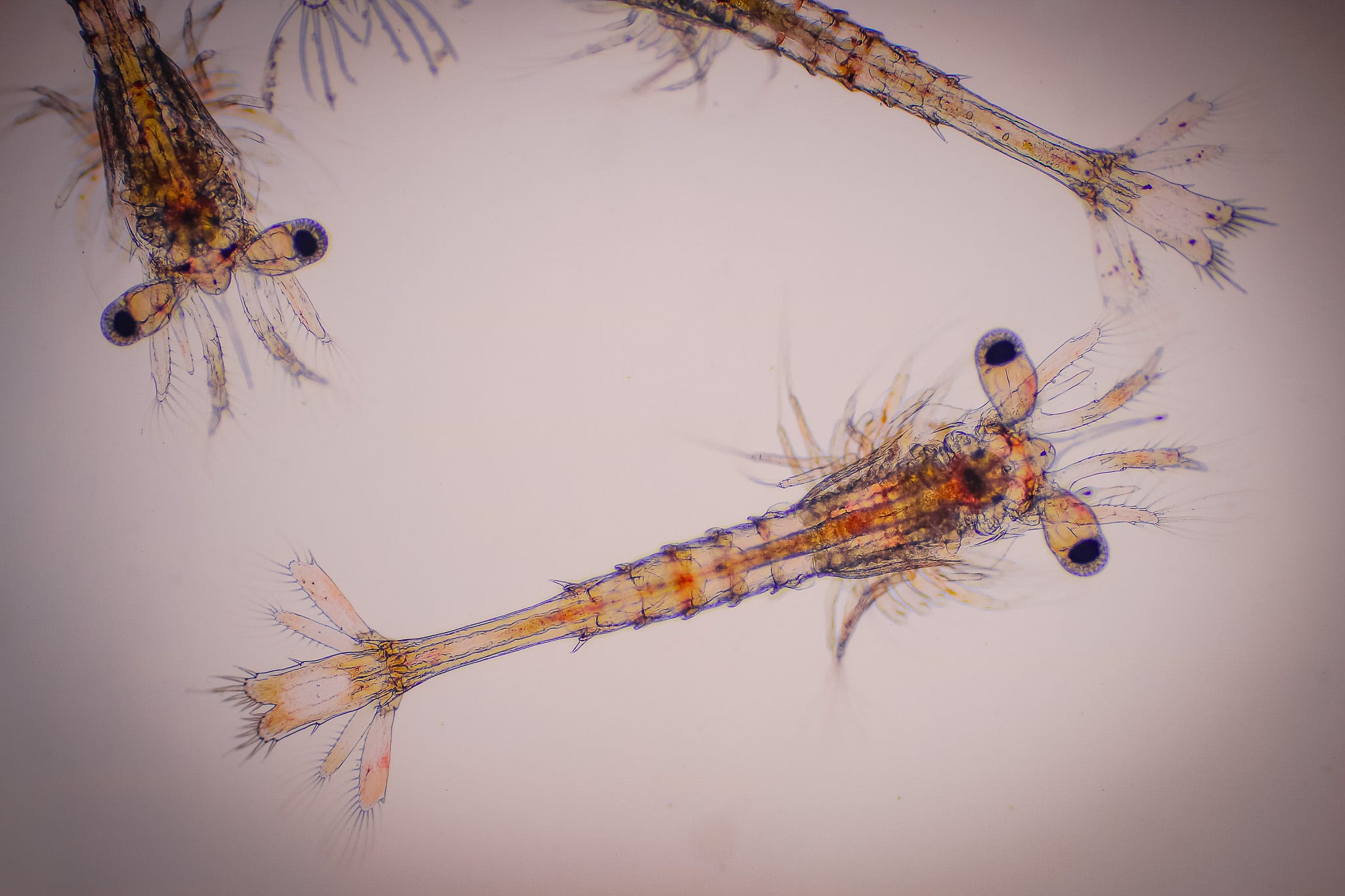
Euphausia superba, the scientific name for Antarctic krill, are translucent crustaceans resembling shrimp. They are mostly transparent with a tinge of red. Because they’re transparent, they also have a touch of green algae visible in their digestive tract. Large black eyes make them adorable when viewed under a microscope (see photo above). When schooled up as densely as 30,000 per cubic meter, krill’s red tinge can color the surrounding water a deep reddish-brown. Krill are a primary food source for whales that migrate to the Antarctic each southern-hemisphere summer. Seals, penguins, seabirds, crabs, squid and other Antarctic fish also rely on Antarctic krill for sustenance.
Scientists are still learning about the tiny crustaceans’ social behaviors. Some krill “swarms” entirely consist of juveniles while other swarms are all female or male. Individuals may live up to ten years and grow up to six centimeters in length. A krill’s dilutive stature belies its hardiness. Antarctic krill survive harsh winters primarily through two adaptations: their ability to go without food for up to 200 days when phytoplankton, their primary food source, is unavailable and downsizing their body mass via moulting. Krill feed on the surface at night, descending to the depths during the day.
The impact on Planet Ocean of this “diel vertical migration (DVM)” is remarkable. Through DVM, krill sequester vast amounts of carbon by feeding on carbon-rich plankton and descending into deeper waters. DVM thus prevents the escape of carbon into the air where it would otherwise contribute to global warming by trapping heat in the Earth’s atmosphere. This daily ascent to the surface also has benefits. A krill swarm carries with it deep water rich in nutrients. These nutrients are essential to phytoplankton development. Phytoplankton are not only a primary food for krill, they are the foundation of the ocean food chain. Without krill’s DVM, phytoplankton would perish.
The downside of Antarctic krill’s daily migration is predictability. Knowing where krill will appear each night makes catching them a piece of cake for industrial krill fishing operations. At the same time that Earle is calling for the end of commercial krill fishing because of the critical role they play in the ocean’s health (“There is no sustainable extraction of krill in Antarctica possible, period”), officials from 24 countries, including the US, are busy negotiating the fishery’s expansion. The krill fishing industry is pushing to increase the annual krill quota by 77% to 1.1 million metric tons. Opposition to this increase includes marine scientists like Earle and a coalition of over 30 conservation organizations including the World Wildlife Fund, Sea Shepherd, the Blue Marine Foundationarine, Greenpeace, and the Pew Charitable Trusts.
How to get involved
Donate to any of the organizations above. I just donated to Sea Shepherd. Leave a comment here after you donate. Planet Ocean needs us. And share this post with a friend!