

Trump marches forward with plan to mine the deep seafloor
In an unprecedented move, the Trump administration announced it’s selling mining leases on more than 30 million acres of America Samoa’s Outer Continental Shelf. This is the latest move in the administration’s “next gold rush” campaign announced in April. An area off the Virginia coast roughly the size of Delaware is also being considered. Commercial deep sea mining has never been allowed before anywhere in the world.
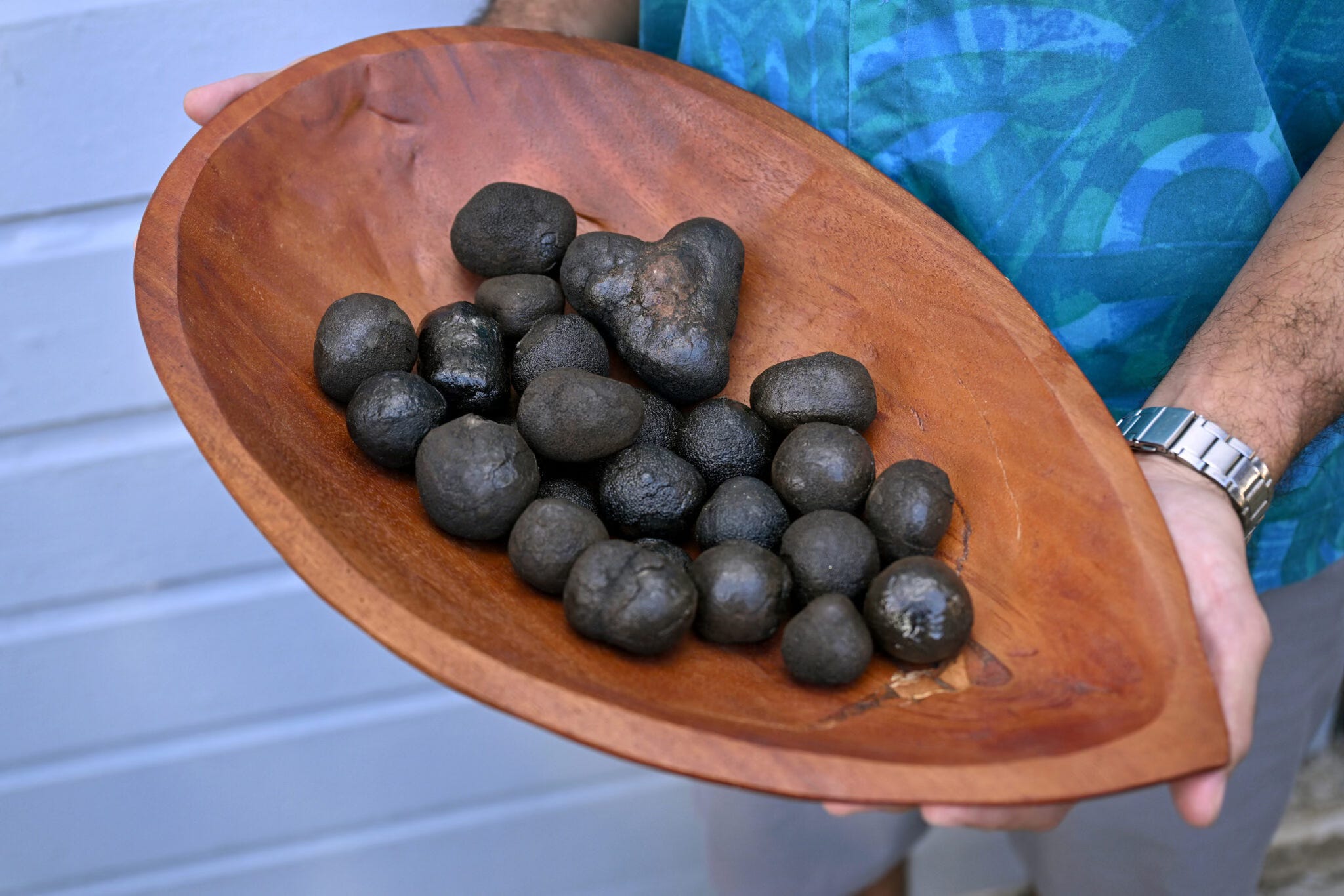
The proposed deep sea exploitation targets mineral-rich deposits called polymetallic nodules. Polymetallic nodules are potato-sized deposits (see photo above) found scattered on the Pacific seafloor at depths of 4,000-6,000 meters (13,000-20,000 feet) that contain manganese, copper, nickel, cobalt and trace amounts of rare earth elements. (I wrote about them in SOS 011). In theory, these nodules can be mined and processed into the raw ingredients of battery tech, weapons, semiconductor chips and AI infrastructure, but deep sea mining has never been done anywhere in the world.
Why is POTUS pursuing deep sea mining with such rabid zeal? One word: China. China currently monopolizes the supply of these critical minerals, controlling ~60% of global rare earth mining and over 90% of processing capacity. The US, and the rest of the world, relies on China for the ingredients necessary to our defense. In fact, China is our sole source for some of the minerals most critical to weapons production: graphite, gallium, yttrium, arsenic and rare earth materials.
While it’s not ideal to give money to a chief rival in order to replenish our increasingly depleted weapons cache, let’s drill down into the benefit of deep sea mining. The primary benefit is security of supply for raw materials necessary to US weapons production and of AI and EV tech development. But the fact is that even if we obtained all the minerals we needed by opening up deep sea mining, we don’t have the capacity to process them. China is still way ahead of us and it will take years if not decades to build out necessary processing infrastructure domestically.
On top of the gap in processing capacity, the negative consequences for Planet Ocean will be nothing short of disastrous. First, the potential extinction of deep sea flora and fauna. Scientists surveying the seabed discover new species with increasing regularity. In the past year, 1,121 previously unknown species were discovered. Second, mining polymetallic nodules could release radiation into the ocean and endanger workers handling the nodules. A recent study found that polymetallic nodules contain dangerous levels of radiation. Mining the nodules will surely lead to the release of that radiation. Finally, deep sea mining techniques cause irreparable damage to the seafloor. The method used to remove polymetallic nodules consists of a vehicle equipped with a powerful vacuum. Nodules are sucked up to a surface vessel along with the top layer of sediment. The effect is an indiscriminate scraping of the ancient ocean floor. Is there a way to mine the seafloor in a sustainable manner? No.
Because we have no certainty around the potential negative impact to the fragile deep seafloor ecosystem and Planet Ocean in general, the only way to prevent irreversible harm to the ocean is banning deep sea mining altogether. Just like the nuclear weapons ban enacted in 2021, there should be a global moratorium on seafloor mining. By doing so, humans can demonstrate their capacity for learning from past mistakes. Pandora’s box can and should remain shut. If you agree, I urge you to make your voice heard by writing to your congressional representatives and/or signing the Greenpeace petition to stop deep sea mining here. The Ocean needs your help!
Ocean Nibbles
♵ Collecting floating plastic harms marine life. The Ocean Cleanup made headlines in 2019 when it used giant ocean skimmers to remove plastic from the ocean surface. Sadly, the skimmers also removed species that inhabit the ocean surface.
🌊 Seabird altruism. A study of black-legged kittiwakes shows that mothers who have an energy-intensive breeding season migrate further in order to ensure a successful breeding season the next year. The cost for this extra effort is a 67% survival rate compared to the typical 83% survival rate.
🐟 Why don’t deep sea fish implode? Fish that inhabit deep water have two ways to cope with the crushing pressure at depth: higher levels of unsaturated fatty acids and they contain higher levels of the chemical that makes fish smell, well, fishy.
SOS Wish List
Freeman 56
Price: $3,000,000-$3,500,000
Freeman Boatworks’ new 56’ catamaran is a battlewagon. Powered by up to 2,400 hp in the form of quadruple 600 hp outboards, the dual hull vessel is capable of cruising at 40 mph for up to 600 miles. No fuel bladder needed here. More information, including how to order yours, is available on Freeman’s website.
Montauk Fishing Report
A lingering low pressure system kept most boats at the dock for most of the week. If you’re planning on fishing today, expect company. We’re all eager to get back to the fishing grounds after several days of land lubbing! Boats that made it out report larger fluke and black sea bass south of the lighthouse and the golden sea bream née porgy fishing remains steady. Further from land, giant bluefin are an ever shortening trip from port. A giant bluefin was caught just 3 miles from the beach! I personally captured footage of one less than 2,000 feet from shore earlier this week. Smaller bluefins are less than an hour away. Yellowfin are also moving closer as warmer water moves in. Send me a message if you get tight!