

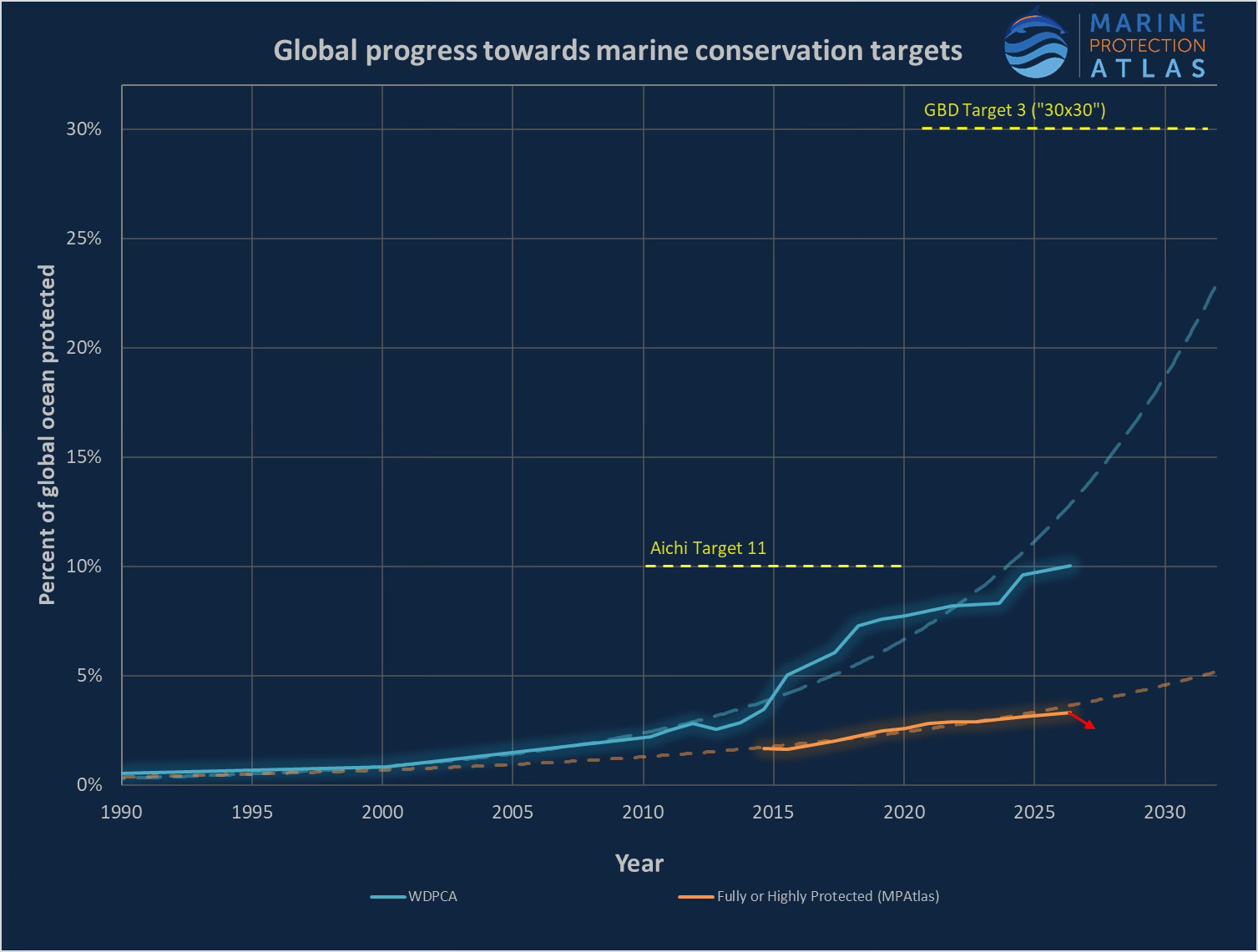
10% 3% of Ocean Now Officially Protected
I’m not great at math. Just look at my budget. But before you judge me, here’s a reminder that scientists aren’t always great at math, either. “Aichi Target 11” is one of 20 targets devised by the Convention on Biological Diversity (CBD) at its tenth meeting, which took place in October 2010 at Nagoya, Aichi Prefecture, Japan. The goal of Target 11 was conserving “10 per cent of coastal and marine areas, especially areas of particular importance for biodiversity and ecosystem services” by 2020. The UN declared victory this week, albeit six years late... Achieving this goal required the global establishment of Marine Protected Areas (MPAs) where biodiversity could flourish. While reported MPAs cover about 10% of Planet Ocean, efficaciousness varies. Is the MPA just a grid on a map? How effective is the enforcement mechanism? Does the MPA even have an enforcement mechanism? Turns out, only about 3% of the world’s MPAs can be qualified as highly effective or fully protected. The remaining 7% are not getting the job done. To see a map of MPAs in your area, check out Protected Planet’s site.
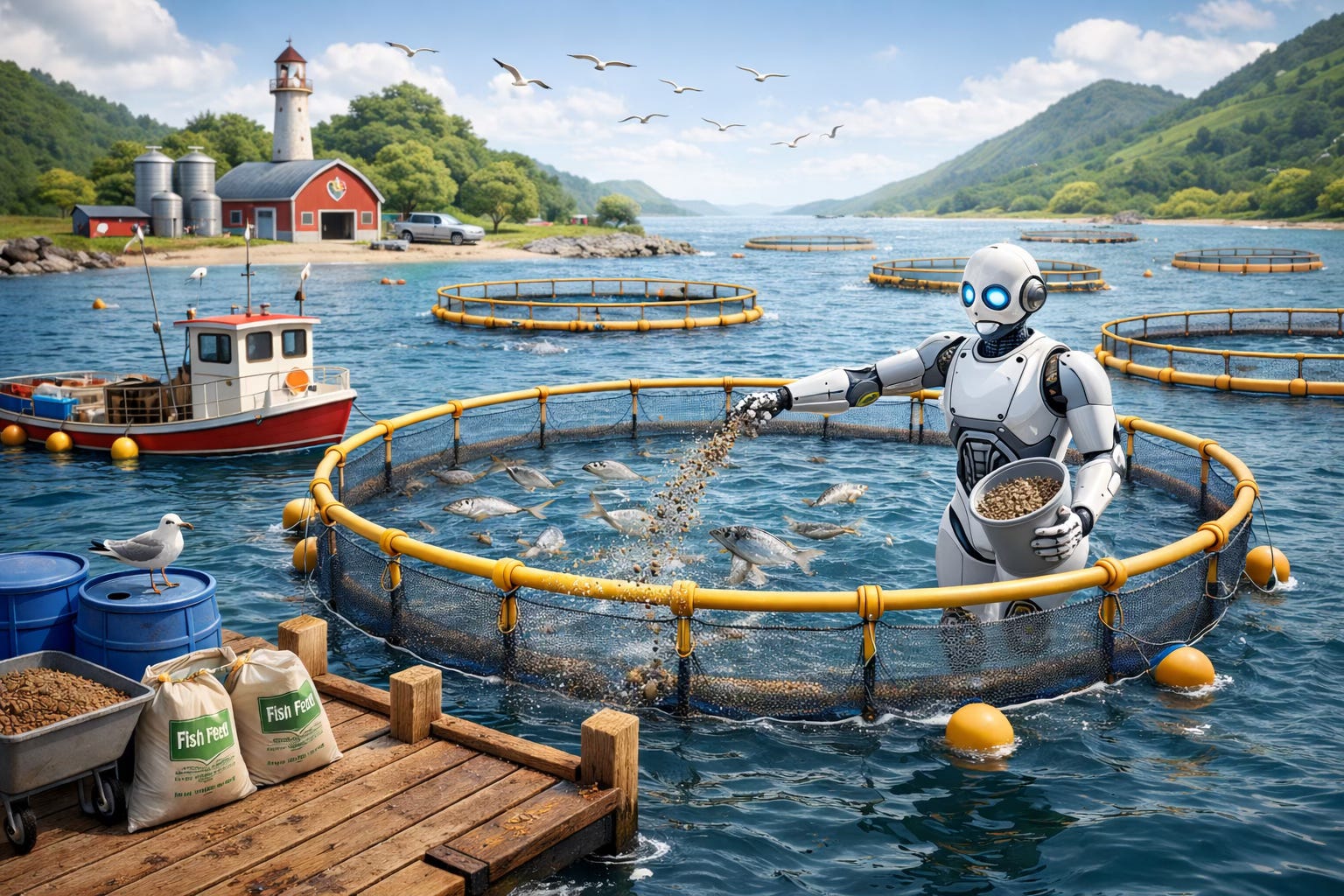
ChatGPT, Design me a Fish Farm
Fish farms have come under fire for their impact on the environment. Excess feed in the water results in bacteria growth and some of that bacteria is harmful to native species in a particular farm’s locale. But don’t blame the farmers. Estimating piscine appetites is tricky. Just ask your fisherman friends. It’s really tough to know how much a fish wants to eat. Which is why fish farms, in an effort to maintain their inventory, tend to overfeed. In fact, gauging feed quantities is the number one challenge in aquaculture. Enter AI. Equipped with AI powered cameras and algorithms, fish farms are getting better at feeding their salmon, tilapia and trout without negative repercussions to the local marine environment. Several companies, e.g. Wisefish and ThisFish, market their AI-forward software to the aquaculture industry. Due to cost, most of the early adopters are industrial scale farms such as Cooke Seafood and Atlantic Sapphire. However, a new business model promises to offer affordable options to smaller operators via an equipment leasing model. According to a recent article on Civil Eats, a single underwater microphone a/k/a hydrophone costs tens of thousands of dollars per pen. Renting the same equipment reduces the cost to a couple thousand dollars a month. Can AI aquaculture be the key to feeding the world in an environmentally responsible way?
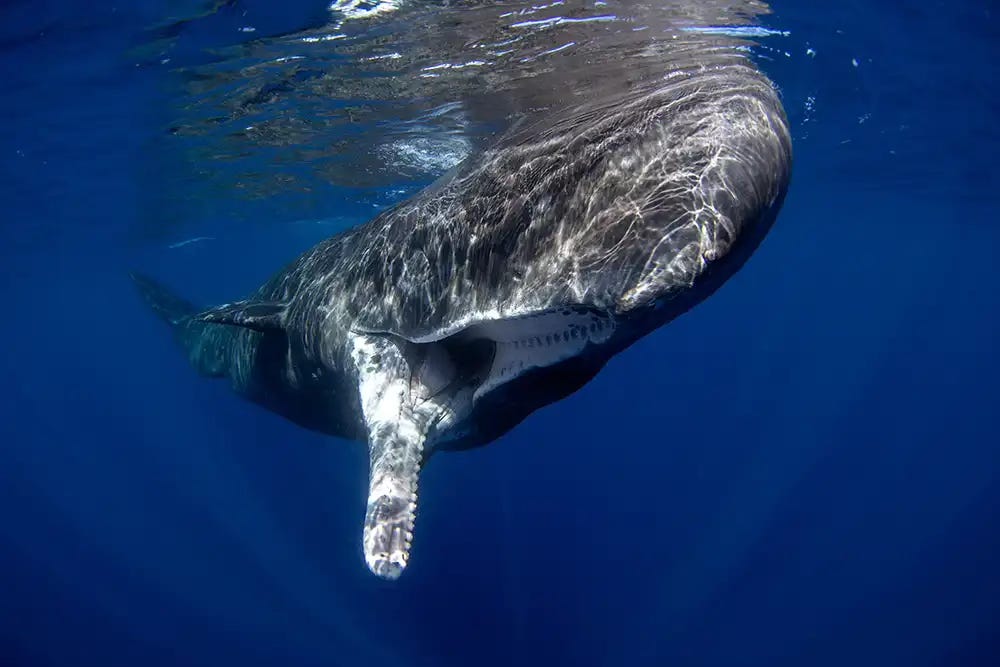
Sperm Whales are Chatty
Sperm whales are eloquent. According to a new research paper, sperm whales communicate using a complex vocabulary of clicks. Stringing clicks together to form phrases known as codas, the whales are able to maintain their characteristic “small, matrilineal social units.” Sperm whale pods typically consist of 15-20 females and their calves. Males leave the pod as they get older, living solitary lives except for mating season when they group into “bachelor herds.” This unique “social complexity and sophisticated behavior” requires strong communication. Researchers even discovered aspects of sperm whale language analogous to human vowels(!). Further, they believe many of the sounds made by the whales are learned rather than innate. We still don’t know what exactly they’re saying, but maybe AI can help. Just ask David Gruber, a professor of biology and environmental science at Baruch College who founded Project CETI to decode cetacean language using a combination of AI and bioacoustics. My dream is to one day be able to know what a whale is telling me, and respond. Am I just dreaming?
Ocean Nibbles
Windsurfers: Love to hate them. I’ve never tried windsurfing, but I gotta admit it looks fun. Still, seeing a windsurfer wipe out is among my guilty pleasures. Now imagine a whale taking out a windsurfer 🤯 Pass the popcorn.
I’m the king of the world! The RMS Titanic sank on April 15, 1912 after striking an iceberg. A recent article in the Cape Cod Times discusses the sinking of the ship and how Bob Ballard found its wreck 73 years later.
Water wings for whales? In an effort to save a humpback whale that’s been stranded off Germany for weeks, rescuers plan to deploy air cushions. It’s been incredible to see the tireless efforts by humans trying to save this poor guy.
SOS Wish List
Van Staal Titanium Fishing Pliers. You already know that Van Staal makes the best surfcasting reels out there. Now you can match your Rolex-adjacent reel with a pair of pliers that promises to last a lifetime or two. Lightweight and indestructible, this is an essential tool for those who spend time semi-submerged while fishing long night in front of Montauk lighthouse. Order yourself a pair from Cabela’s here.